Thoughts, news, and more
Recent posts
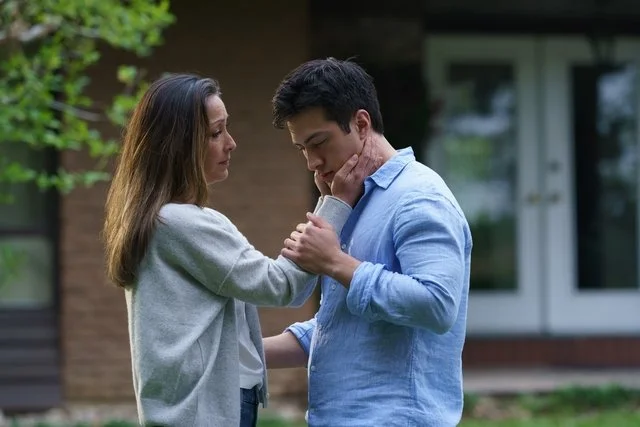

And now for something a little different…
I generally reserve my website for things related to my artwork or the workings of my studio. I’m posting this essay here partly because I need a place to park it besides Facebook, and partly because it touches on the core of who I am and is thus related to the art I make. If this topic isn’t of interest to you please feel free skip this posting and know that I will continue posting occasional updates about art here and on my studio Facebook page and Instagram feeds.
And then I asked them to pray!
Russ Little, 16 June 2020
Over the past two weeks I’ve called on a wide circle of family, friends, colleagues, and acquaintances to pray for my husband, Dan, who is in a trauma ICU fighting to recover from a near-fatal car crash.
I asked people to pray, and that’s made me think a lot about what exactly that means. What is prayer? What does it mean for me to make such a request? What is my own prayer life like? Is it hypocritical to ask for something that I’m not even sure that I do all that well? Part of the way that I’ve been working my way through these thoughts is by writing this short statement—writing it and rewriting it.
I’m not especially interested in proselytizing, evangelizing, or any other “izing.” I think that faith is a very personal choice and I believe that it’s arguably a faithless act to assume that only one tradition or belief system is right, and thus all others are inherently wrong or evil. So, you do you. As long as that means that you’re kind to others, strive to practice diversity, equality, respect, and love, and you’re grateful for the good things in your life, then I think we’re both headed in the same direction.
And yet, I asked people to pray. What if the concept of “prayer” is foreign, off putting, or downright antithetical to your own beliefs? Am I adding to the grief and confusion folks are already feeling about this terrible accident by throwing prayer into the mix? I think the answers lie in a shared understanding of what prayer means to me. If I take this moment to say a little more about my own understanding of this particularly loaded word, “prayer,” then… We’ll, I don’t know. Maybe we’ll all be more comfortable.
I’m not going to regurgitate what I’ve been taught about prayer. This is what I personally believe—prayer according to Russ. I use prayer as an umbrella term to encompass the many forms of mindful contemplation, by which I mean gently holding a thought with an open mind, an open heart, and a willingness to welcome new feelings, insight, or healing. My thoughts about formal intercessory prayer (asking for a specific thing on behalf of another) are complicated. I’m not comfortable with the notion of a quid pro quo relationship with the universe—“If I say X or promise Y, then Z will happen”. But, I do pray for others. I think prayer does two things, one tangible and one intangible. First, I think that prayer—mindfulness, presence, contemplation, and openness—can be a source of personal growth and healing. It can make your own life better, and a healthy, grounded you means an incrementally healthier world. Second—and this is the harder part to embrace—I believe that the same prayer that expands your own heart and mind has the potential to reach others, either through a change brought about in you or through some intangible and inexplicable metaphysical shift.
So, when I ask you to pray for Dan, me, and our family, what I’m asking is for you to bring us into your mind in those quiet moments and hold us in love. My hope is that this will bring you peace and hope and that some of that will spill over to Dan himself.
As to the mechanics of prayer, they don’t need to involve mats, altars, incense, icons, beads, or other appliances unless those things help you. The two best prayer times for me are while walking and when I’m in the studio. I’m a working studio artist. When I’m painting, drawing, or stitching it’s helpful for me to disengage as much of my conscious mind as possible as a way of opening up creative flow. A quieter mind also allows me to hold a concern or another person in my heart while I work. Walking does a similar thing. Getting out of the house and putting one foot in front of the other creates a similar kind of open inner space. I also use prayer beads, not a rosary but sort of. Working my fingers slowly along a circle of beads as I walk helps me to hold focus on a specific thing—or gently return to that focus when I drift. It’s a balancing act between focusing and not focusing so much that you close your mind to all else. It’s also worth noting that keeping the beads in your pocket while you walk might be discrete but it also looks a little...um...suspicious.
If you’ve read this far then you have my thanks. I hope that by sharing these thoughts I’ve created a place of common ground between us. Prayer need not be the elephant in the room. Feel free to call it by another name that’s better aligned with your own beliefs. I hope that some form of prayerful engagement will bring you peace, improve our world, and bring healing and grace to those you love.
With love,
Russ
My video interview as "Guest Creative" for Jane Dunnewold's Creative Strength Training seminar
A few weeks back I had the genuinely delightful opportunity to sit down for a conversation (via Zoom) with Jane Dunnewold. Artist, author, teacher, and mentor, Jane created and now facilitates a program called, “Creative Strength Training.” Each month she interviews a fellow artist as part of the “Guest Creative” component of the program. When she asked me if I’d be willing to sit for an interview I leapt at the chance. Who wouldn’t? Conversations with Jane are always a perfect combination of easy, free flowing, and substantive. This one was no exception. Click the link below to watch our discussion.
I confess that I’m usually horrified at the sound of my recorded voice and by the way that I come across on video, but this is an exception. I have to credit Jane and Zenna (Tech Consultant at Jane Dunnewold Studios) for making the entire process easy, putting me at ease, and posing stimulating questions. Thanks for this wonderful opportunity.
Visit my booth this weekend at the Greenbelt Festival of Lights Art & Craft Fair
It feels like the Thanksgiving dishes are barely in the dishwasher yet suddenly it’s December and we’re anticipating the next round of holidays with all of the associated gift giving and merriment. I’ll be doing my part this weekend, selling my originals wearable art scarves and shawls at the Greenbelt Festival of Light Art & Craft Fair. I hope you can make time in your weekend plans to stop by to see my newest creations as well as the work of other local artists. This is a juried show and it consistently attracts a good group of talented artists selling their own original fine craft and art. It’s also a great way to shop locally and support artists in your community.
When:
Saturday, Dec 7, 10 AM - 5 PM
Sunday, Dec 8, 10 AM - 4 PM
Where:
Greenbelt Community Center, 15 Crescent Rd, Greenbelt, MD 20770

Check out the Aug/Sept 2019 issue of Quilting Arts!
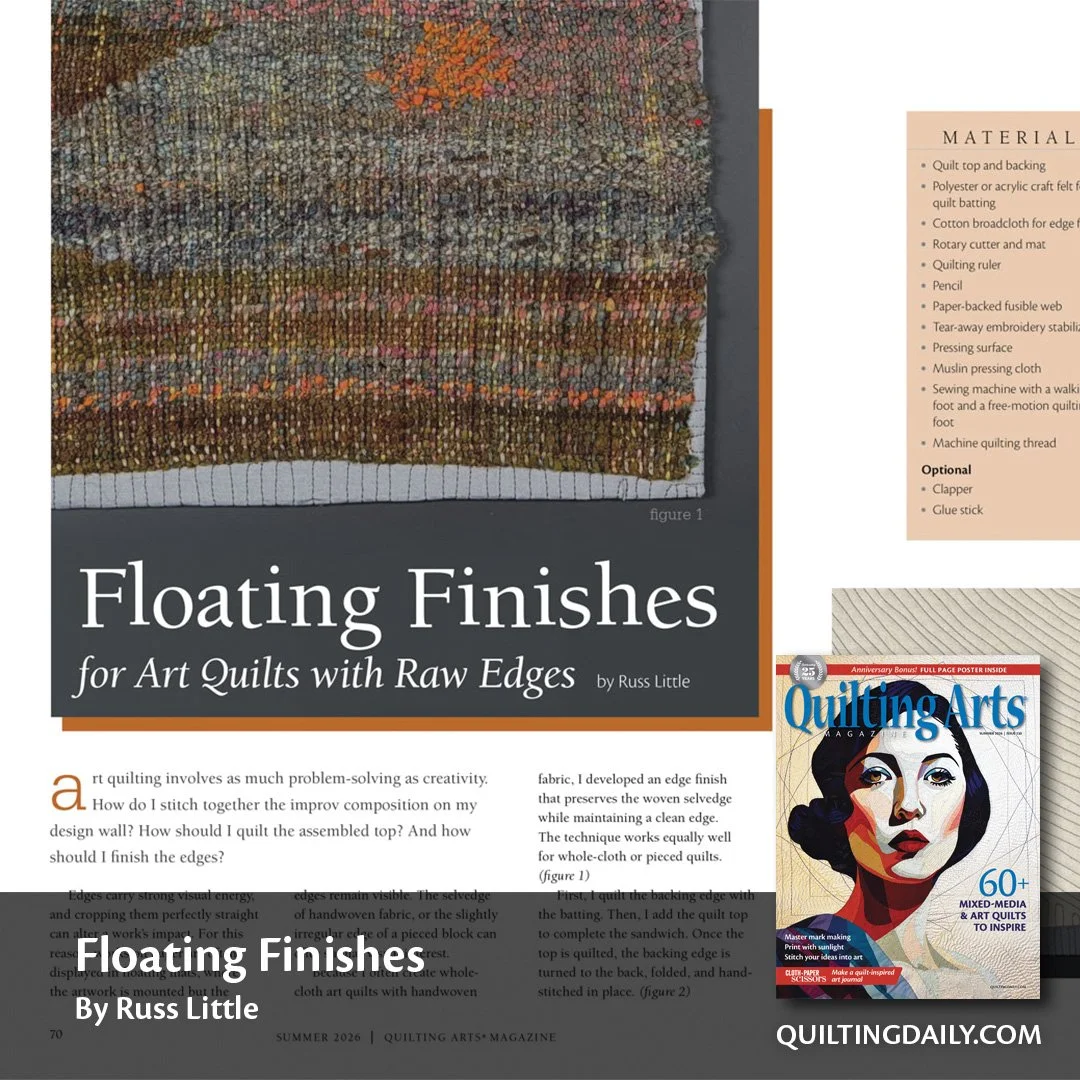
The Art Cloth Network is featured in the Artist Profile section of the current issue of Quilting Arts (Aug/Sept 2019). Better still, an image of my quilt (Interplay #1) is the full page opener to the article! I don’t often get this kind of exposure, so I’m thrilled to say the least.

The issue is on news stands now in case you’re already a subscriber or happen to be perusing your local magazine rack. See the links at the end of this post for information about ordering print and digital copies.
Many thanks to Barbara James and Deborah Weir from ACN for working to get this opportunity for our group, to Cate Coulacos Prato for her excellent article, and to the Quilting Arts editorial team for a taking and interest and giving us such lovely coverage.

Print copies of the Aug/Sept issue are available at:
The digital copy is available at:
Special thanks to Quilting Arts for granting permission to reproduce the images included in this blog post.
I’m donating to HIAS and I want you to help

The November midterm election results give me hope that the pushback against hatred is gaining ground. But, the undeniable truth is that we live in troubling times and there’s still much to be done. Consider the following.
On Saturday, Oct 27, 2018 an anti-Semitic terrorist stepped into the Tree of Life Congregation Synagogue in Pittsburgh armed with an automatic rifle and multiple handguns. He then murdered 11 people and wounded 6 others, all of whom were gathered for worship.
In a country where words like Pulse, 9-11, Oklahoma City, and Charleston Emanuel AME are etched into dark and tearful places in our minds, why does this latest atrocity stand out? It’s the antisemitism. It’s the hate-filled killing of innocent people, several old enough to have already witnessed and experienced more than enough suffering for a single lifetime. It’s the attack on people in a holy place in the very act of worship. It’s the terrorist’s bigotry that he twisted into a rage over the work of the Hebrew Immigrant Aid Society (HIAS) and their efforts to help people fleeing danger and persecution.
It’s not the first hate crime, and it won’t be the last. But, for me it was the last straw for that particular week—one already marked by other acts of violence and remembered violence. There are undoubtedly mental health considerations in all of these cases. I just can’t accept that humans are born to hate and kill one another. So, while I’ve been mulling that over, wondering how to forgive and how to have hope, I’ve been thinking about other things.
Since the attack I’ve taken the time to learn a bit more about HIAS, their history, and their work. You can read about the organization on their website at https://www.hias.org, or you can visit Charity Navigator (https://www.charitynavigator.org/index.cfm?bay=search.summary&orgid=3820). For now, I can think of no better response to these killings than to do good in the face of evil, and to do it in a way that’s diametrically opposed to the supposed object of the terrorist’s rage.
That’s why I’m donating to HIAS, and I want your help. Here’s how.

I’m offering 8 wearable art scarves for sale and donating 100% of the sale price to HIAS.
Each of these lightweight cotton scarves features affirmative words appropriate for our present situation, and patterning reminiscent of…well let’s just say “past times of protest” and leave it at that. Let’s work together to push back against the darkness and send a positive message and good energy out into the world draped around your neck. Click the SHOP button in the menu above to visit my online store and select “HIAS Fundraiser” from the lefthand column.
The fine print:
When I say 100%, I mean 100%. I will absorb all of the credit card processing fees and material/labor costs. All I ask is that you pay the sales tax and shipping costs. So, purchasing a $60 item results in a $60 contribution from me to HIAS.
I’m not operating a 501(c)(3) charitable organization, so yes, you do need to pay sales tax on this purchase; and no, I cannot provide a gift letter for your income tax preparer.
In order to give everyone equal access and make this truly a first-come-first-served kind of thing, all purchases must be made by credit card through my online store.
If you live locally and would like to arrange to pick up your scarf at my studio, go ahead and complete the purchase online and use the code HIASFUNDRAISER during checkout. This will apply a $7 discount to your order, thereby reversing the shipping charge. You must then contact me to arrange a pickup time ASAP.
Sharpening the Saw, or Barn Time
It’s been years since I first read Steven Covey’s book, “The 7 Habits of Highly Effective People.” At the time I found it refreshing and inspirational. It’s back in my reading queue, and I’m curious to see how it’s stood up to the passing of more than a few years. I mention this book because I’ve always remembered that Habit 7 is “Sharpen the Saw.”
Let’s say you have a wonderful saw that cuts perfectly. Maybe it’s one of those beautiful, precise Japanese ryobas. If you spend all of your time sawing things and never take time out to clean and sharpen it, the saw will gradually become rusty and dull, and eventually useless. So too with humans—and I’m going to go further and say artists in particular. We all need to allow time for rejuvenation, growth, learning, and connection with both other people and nature. This week I had some of all of those things at the Crow Timber Frame Barn in Baltimore, OH.
The Barn is a study center for art quilting and other related media and methods (e.g., textile surface design, dye methods, and foundational art skills like 2D design and color theory). I’ve been here many times over the last decade, and it’s become a touch point in my life for learning and renewal. It’s that way for many people. and it’s evolved into a sort of community. Coming back is a little like a family reunion.
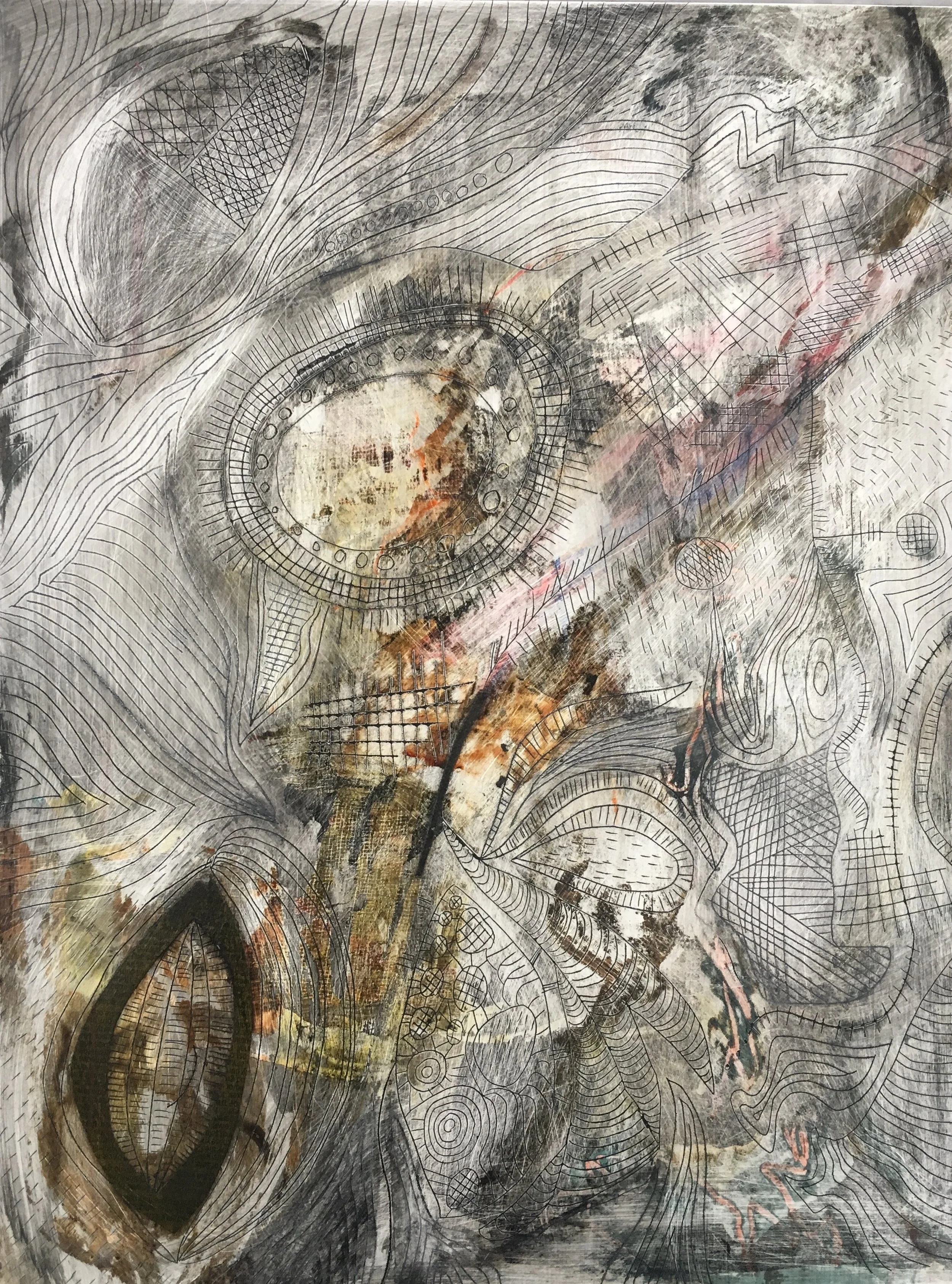
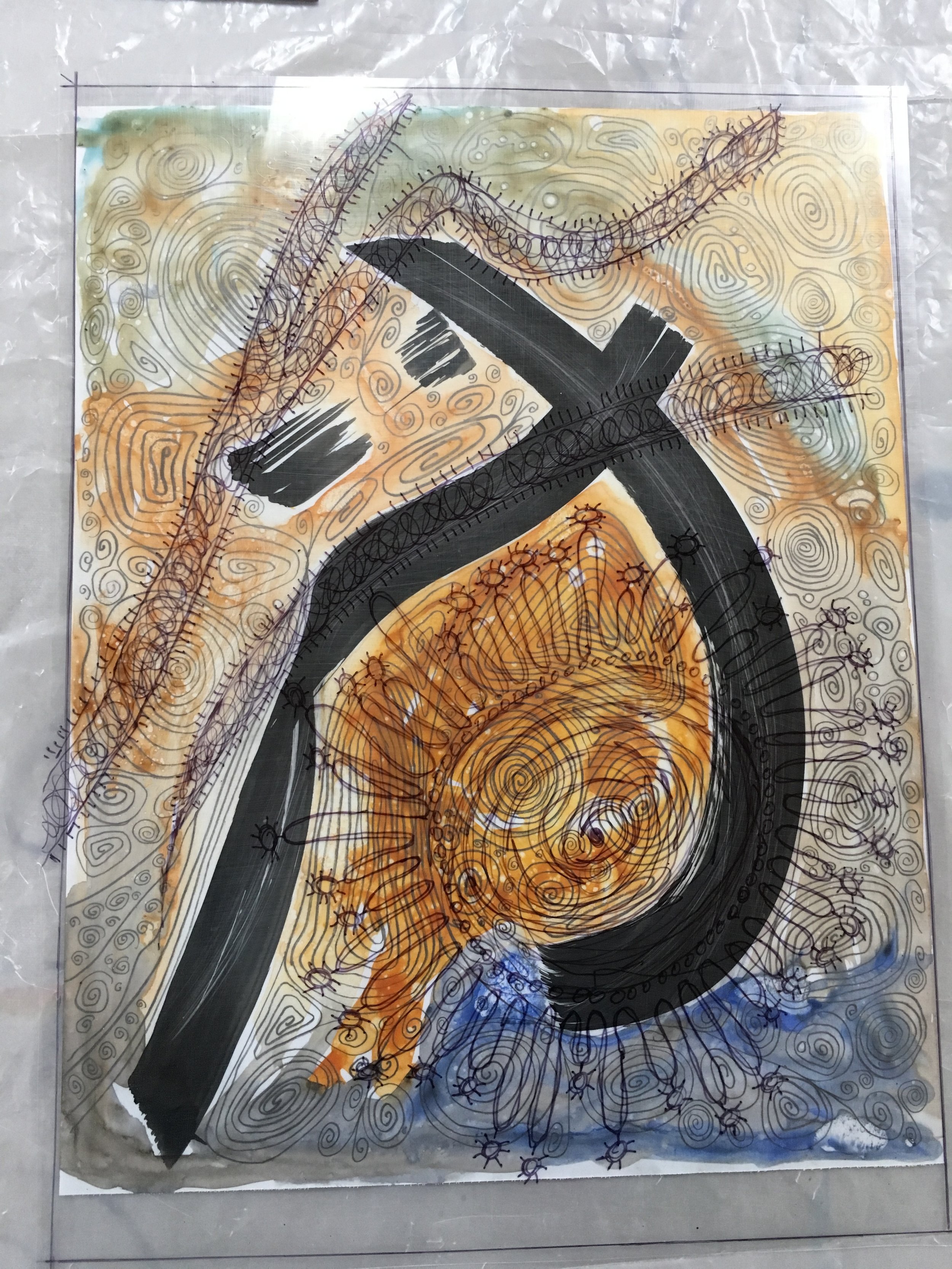
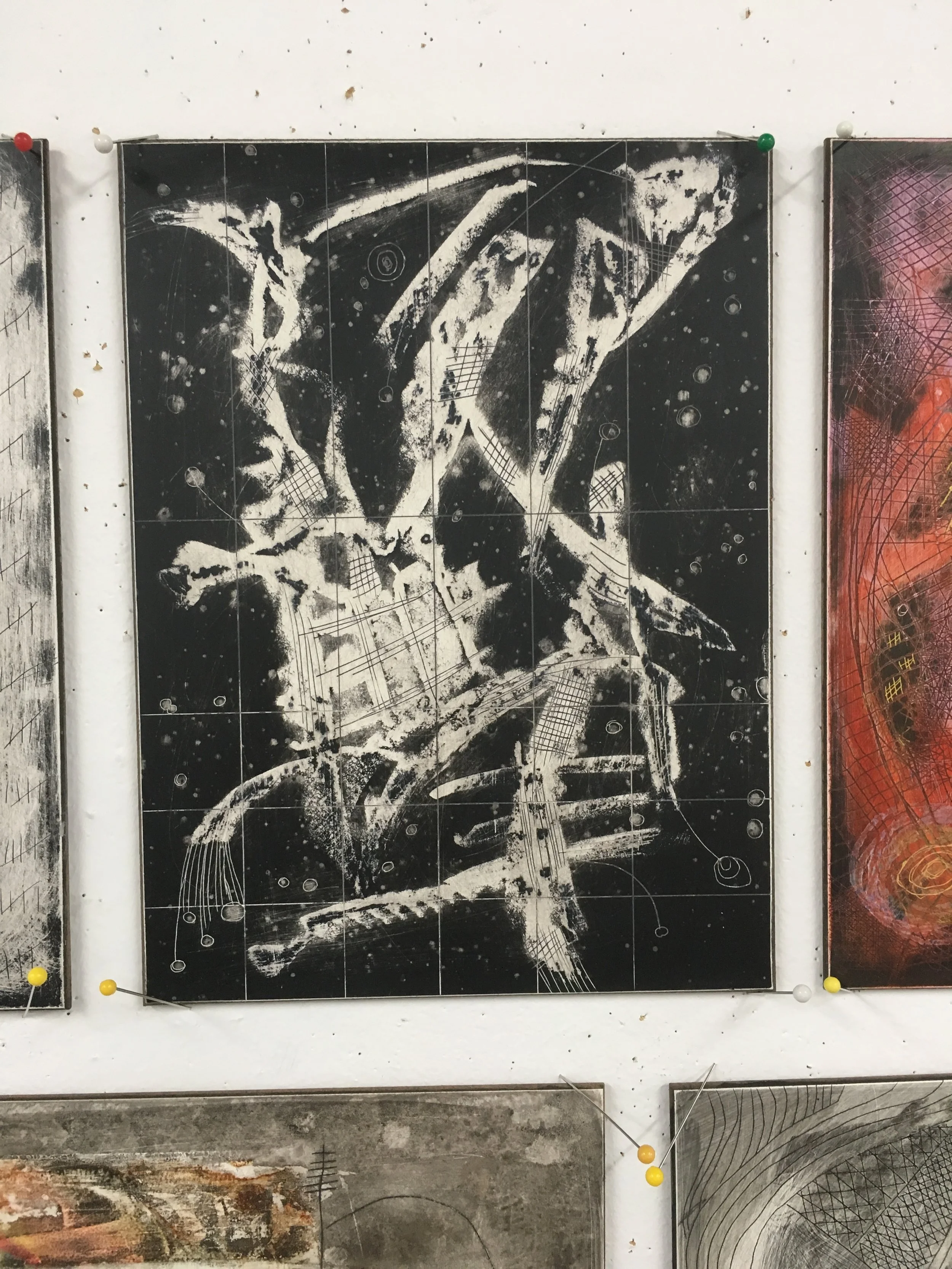
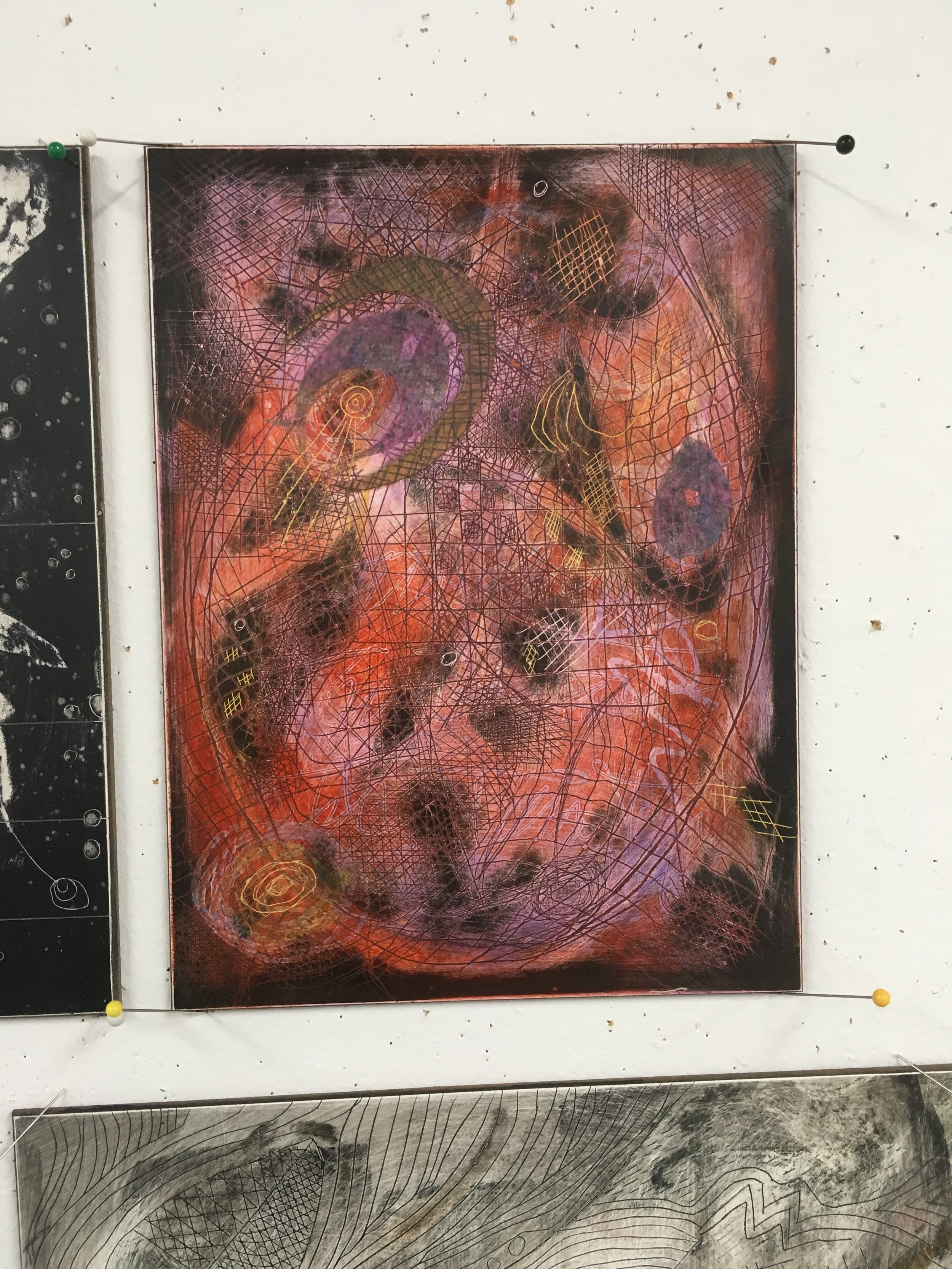
This week I had the wonderful experience of participating in an intense 5-day painting and collage workshop with Deborah Griffing. We drew, painted, screen printed, and collaged; we experimented with new materials, and I got some hands-on experience with oil-based media. It was fantastic. The things that I created are all workshop exercises, but they’re exciting nonetheless. Everything is a departure from the way that I’m currently working and from the marks I’m currently producing. I’m taking home new experiences and new ideas, but it all needs to simmer around in my head for awhile before I can really see if or how it will change my work. But—and it’s a big but—it was just good to break out and try new things; to exercise different parts of my artistic brain.
The piece in the photo above measures 9 x 12”. It’s ink, cold wax, oil pastel, and water color on clay board. The lines are engraved into the clay surface. It’s time consuming, but so satisfying. It also taught me about the value of spending even more time developing the surface of a composition. A few more of my workshop pieces appear below. Click any of the images to page through larger images in a gallery. They’re a mixture of works on paper, board, and yupo (a plastic “paper”) using a who range of media and technique.



A major milestone: QUILT NATIONAL 2019!

Outward Movement #1 (2018)
I have some exciting news to share. This week I reached what feels like a major milestone. One of my art quilts, “Outward Movement #1,” was accepted into Quilt National 2019. Quilt National is a biennial quilt show that attracts entries from all across the world. It’s among the top tier of art quilt shows, and it’s been a stretch goal of mine for several years. This is my first acceptance after a number of attempts. To say that I’m thrilled and honored is an understatement. Over the moon is a little more accurate. When I read the acceptance email I had one of those gasping/laughing/crying moments. Let this be a lesson not to read email at stop lights. I told a few people right away, but have been keeping this to myself for a couple of days, just letting it roll around in my head and heart while I remember the great teachers, mentors, and colleagues who’ve helped me learn and grow. Thank you all.
You can see more images of the quilt and read more details in my portfolio.
This quilt was created using the hybrid manual/digital techniques that I’ve been writing and talking about for the last couple of years.
From paper to fabric: Surface design methods that embrace the intersection of manual and digital design
This article originally appeared on the Art Cloth Network blog in March 2018 (http://artclothnetwork.blogspot.com)
This is the second of two articles that deal with my ventures into digital fabric printing. The first article dealt with digital printing in the context of my larger journey and identity as a fiber artist. This time I want to discuss the different sorts of digitally printed cloth and the ways in which I’m using digital printing--ways that I believe are a bit different from what I’ve seen from other artists.
The type of designs and images digitally printed on cloth can be organized into several categories:
- Utilitarian: Banners or other signage that were once screen printed and are now produced on a digital printer.
- Yardage: Traditional repeat patterns of graphic elements, or an abstract, non-repeating pattern printed on cloth to produce yardage for garments, home dec items, etc.
- Faithfully rendered photographs: Think of a memory quilt that incorporates photos of your grandparents printed on fabric.
- Manipulated photographs: Colorized, filtered, and altered images typically printed with the intention of making art.
- Computational art: These are designs created entirely within a computer program specifically designed to create digital images. For example a program that creates fractal designs.
- Whole cloth compositions: A length of digitally printed cloth that is a finished product or a step along the way to creating a finished artwork. Subsequent steps might include dyeing, painting, stitching, cutting, etc.
You could easily argue that the boundary between these last two categories is a little fuzzy, but for me the distinction is whether or not you start with one or more photographs.The work that I’m most interested in falls in this last category. I think we can break this group down still further and say that these whole cloth compositions can be:
- Created entirely in the computer through drawing, manipulating images, or using a computer program to create an image.
- Created in a hybrid manual/digital space that involves creating a design on paper, scanning or photographing that work to get it into the computer, then manipulating the image further to create a result that is ready to print on fabric.
With some trial and error I’ve settled into two work methods within the hybrid manual/digital approach, embracing some of the best of both paper and fabric. Specifically, I’ve found that the mark quality that I get from cutting paper with an X-ACTO knife is completely different from what I get when I cut fabric. The resulting compositions are different as well. It’s as if this way of working taps into a different part of my brain with its own distinct voice. These two methods both rely on digital fabric printing technology--wide carriage inkjet printing on fabric (I’ve been using spoonflower.com). I’m calling them “Digital design using hand cut elements” and “Paper compositions rendered on fabric”. There are pros and cons to each.

A composition created using the "Digital design using hand cut elements" method
"Nuclear Family", Russ Little, 2015 (digitally printed cloth, quilting)
Digital design using hand cut elements
The goal of this approach is to use cut paper to create marks, shapes, and motifs that can be scanned into the computer, and then used to create a composition on a background. Here’s how I do this.
- Paint black paper. Depending on your intended design you can create a very dense black or something with more visual texture and brush strokes. Alternatively you can use black construction paper, but I prefer the visual and physical texture of the paper I paint myself. I use a variety of papers including old newspaper, receipts, found bits of paper, and Bienfang Graphics 360 marker pad.
- Cut shapes and linear elements. The goal is to build a vocabulary of curved and straight lines, both thin and thick, as well as a variety of shapes.
- Glue the shapes and lines to white card stock. Uhu glue stick is my preferred adhesive. You’re not trying to create a composition, just get them on the page without overlapping.
- Scan or photograph the resulting pages, then store the originals someplace flat, dry, and safe so that you can return to them in the future if necessary. I use sheet protectors in a loose leaf binder.
- Open the image file(s) in a graphic editing program (e.g., Adobe Photoshop or Illustrator). From here you can select and copy your individual shapes then scale, stretch, rotate, flip, and colorize them to meet your needs. The reason for creating these shapes in black is so that they can be easily selected, then black can be replaced with other colors.
- Build your composition in a separate file by copying and pasting your shapes and lines onto a background of your choice.
- When the design is finished, upload it to an online printing service or take the file to an appropriate local print shop for output on fabric.

Cut paper shapes ready for scanning
Pros
Because all of the elements exist as separate objects in your digital design, you can easily move them around until the composition is to your liking. You can also create an unlimited number of variations.
Cons
The computer is a wonderful tool, but I find that sometimes the technology can be a little cold and detached, creating a separation between the artist and the work. I don’t get the same feeling from this process that I do when I’m working exclusively on paper.

A composition created using the "Paper composition rendered on fabric" method
"Collage #1", Russ Little, 2017, (cut paper collage digitally printed on cloth, quilted)
Paper compositions rendered on fabric
The solution to the coldness of the computer is to leave it out of the process entirely until it’s absolutely necessary. This is currently my preferred way of working:
- Paint paper in a variety of colors (a full range of hues and values; don’t forget the neutrals).
- Prepare a painted background on card stock.
- Cut the shapes from your colored paper required to create a composition.
- Arrange the shapes, lines, etc. on the painted background.
- Add other drawn or printed elements to the composition if appropriate.
- Glue the shapes and lines in place on the background.
- Scan or photograph the resulting composition, then store the original someplace flat, dry, and safe. As noted above, I’ve been storing my work in sheet protectors in a binder.
- Open the image file in an image editing program (e.g., Adobe Photoshop) and do whatever retouching, adjustments, or color correction is necessary. Crop or scale the image as needed.
- When the design is finished, upload it to an online printing service for output on fabric.
- For me, the final, optional step is often to layer the printed fabric with batting and backing, then add dense quilting that speaks to the printed design. I often incorporate hand stitch as well.
Pros
The design work is completely analog. The computer is only used as a means of getting the resulting composition printed on cloth. Working this way keeps me slow and focused and avoids those times when I get lost in trying to figure out how to do something using Photoshop that I can easily do by hand.
Cons
To my way of thinking there aren’t many cons to this method, except for the one that’s inherent in all works of the hand. Unlike the digital design method described above, when you cut something it’s cut; when you make a mark it’s made. There aren’t too many easy undos, but isn’t that part of the fun?
Technical and design considerations
There are several technical considerations to bear in mind when using either of these hybrid manual/digital methods, particularly if you are using the second approach to prepare an entire composition on paper for later printing on cloth.
Resolution and scale
If you prepare your cut shapes or your entire composition at a size smaller than you intend to print it, then you will need to enlarge your image before printing. That means that you need to consider two things:
- Understand the relationship between the image resolution from your camera or scanner and the final resolution required for printing on cloth. Some manipulation of the resolution will be required and you need to consider the resolution requirement of the printer.
- Regardless of image resolution, if your final printed cloth is larger than your original paper composition, then you are scaling up. That scale change means that you need to plan for your design elements to be enlarged or you need to work on larger paper. Those delicate marks on your paper design can become a lot less elegant at 400%.
Photographing and scanning
If possible and practical, use a flatbed scanner to create an image of your paper composition. You might still need to do some color adjustments, but your work will be held perfectly flat, lit evenly, and imaged at a high resolution.
If your work is too large to scan (e.g., larger than 8.5” x 11” or 8.5” x 14”), then you can either scan it in sections or photograph it. Scanning in sections requires planning up front. For example, will you build your design across several sheets of paper or will you work on one large sheet and cut it into smaller pieces for scanning? Ultimately, these individual images will need to be combined to form a single seamless image.
If you’re photographing your composition because you don’t have access to a scanner or don’t want to cut up a piece that’s too large to scan, then it’s important to photograph the piece as flat as possible, light it evenly, fill the camera’s viewfinder as completely as possible to maximize resolution, and make certain that your camera is square to the plane of the artwork (i.e., not tilted, twisted, or angled). Use a tripod and focus carefully to insure that the image is as sharp as possible.
Color correction and management
To get the color from your printer that you want on your final cloth you’re going to need to pay close attention to color throughout the process. That likely means color correcting what you’re getting out of your camera or scanner, working on a color corrected monitor, and accounting for the color profile of the printer that will be used to create your fabric. Alternatively, you can just not stress over color and accept what you get back from the printer.
Text
Finally, if you incorporate painted newsprint or any other paper with visible writing on it into your composition, realize that even if the text is upside down and backwards the viewer will try to read it and assign meaning to it. Be intentional in your use of text and pay close attention to the amount of text that is visible on your painted paper.
Products and services referenced in this article:
- Adobe Photoshop (https://www.adobe.com/products/photoshop.html)
- Adobe Illustrator (https://www.adobe.com/products/illustrator.html)
- X-ACTO #1 Precision Knife (https://www.dickblick.com/products/x-acto-1-knife/)
- Uhu Stic Glue stick (https://www.dickblick.com/products/uhu-stic-glue-sticks/)
- Bienfang Graphics 360 marker pad (https://www.dickblick.com/products/bienfang-graphics-360-marker-paper/)
- Spoonflower.com online digital fabric printing service
- Staples medium weight sheet protectors (https://www.staples.com/Staples-Standard-Sheet-Protectors-100-Pack/product_40713)
Wrestling with surface design guilt
This article originally appeared on the Art Cloth Network blog in March 2018 (http://artclothnetwork.blogspot.com)
This is the first of two articles that deal with my sojourn into digital fabric printing--the why and how of it and what it means in the context of my larger journey as a fiber artist. We’ll start with the big issues in this article. I’ll dig into the methods in the next one.
I’ve been dyeing and printing fabric for close to 20 years, and I still find it exciting. I love the process of getting color onto and off of cloth. I love the details--the measuring, weighing, and calculation--that allow me to create predictable, repeatable color. I love the toolmaking--carving relief printing blocks, designing and burning silk screens, and gathering found objects that become mark making implements. I love painting and printing big pieces of cloth. And then, of course, there are all of the things that happen to that printed cloth. It becomes art cloth for the wall, it gets quilted or stitched, or it becomes art to wear--one of a kind scarves or jackets. Lately though, I’ve been wrestling with a guilty feeling that I’ve been disloyal to my craft, or at the very least veering off on a tangent.

"Illumination: Counting"
Hand dyed art cloth
Russ Little, 2013
In all of my time as a dyer, I’ve been a quilt surface designer. I’ve made pieced quilts as well as quilted whole cloth paintings. But, for the last year or so, the thing that’s excited me the most is cut paper collage. I paint paper--drawing paper, found bits of paper, old newspapers--with gouache in an array of colors, then cut it into shapes and arrange them to form a composition. This method is anything but new. Many artists have worked in collage, Matisse being not the least among them (try Googling “Matisse collage”). To give credit where it’s due, I started getting excited about collage through workshops on color theory, collage, and design that I’ve taken with David Hornung.
Collage takes many forms: combinations of found images and/or text, combinations of solid color shapes, figurative, abstract, the whole gamut. You might say that the term “collage” is a big umbrella term that covers lots of forms of “sticking stuff to paper”.
For me, there’s something totally different that happens in my brain when I’m cutting, arranging, and layering paper compared to cutting and piecing fabric, or even painting directly on fabric. Designs and motifs emerge when I cut into paper with an X-ACTO knife that are completely different from what happens on my design wall with fabric. But I still want to work in fabric, and I want to incorporate the textural layer of quilting into the final composition.

"Collage #3"
Cut paper collage digitally printed on cloth, quilted
Russ Little, 2017
With some trial and error I’ve found my way to two work methods that embrace some of the best of both paper and fabric. They both rely on digital fabric printing technology--wide carriage inkjet printing on fabric. I create shapes or full designs on paper, scan or photograph them, then send them to a service provider for printing on cloth. When I receive the printed cloth I can them treat it as finished art cloth or add more layers to it through paint, stitch, quilting, etc. Detailed discussion of these methods will be the subject of the next article in this series. For now it’s enough to know that I’m allowing a computer to put dye/pigment on cloth, rather than doing it with my own two hands.
So, what’s all this hand wringing about “surface design guilt”? Well, it comes down to the simple facts of change and that newest of buzzwords, disruption. I’ve spent years building knowledge, skill, and experience in the manual work of hand dyeing and printing cloth. Now I find that I’m able to create a finished work of fiber art without ever touching dye or fabric paint, and it makes me a little uneasy. It sometimes feels inauthentic. Heretofore, part of the challenge--the foundational craft in this particular art form--has been the skillful manipulation of dye, paint, and cloth to produce the desired result. The computer and printer certainly bring their own set of challenges, but those aren’t generally surmounted using the skills I’ve worked so hard to learn.
In the end, the peace that I’ve made with all of this is perhaps the same peace that others have made. As artists we must embrace new opportunities, tools, and ways of thinking, while remaining grounded in those traditional and foundational skills. Perhaps a fitting comparison might be that a artists using a knitting machine is probably better able to make effective use of that tool if they first learn to knit by hand.
I also wonder about the future. I hope that young artists will continue to learn about traditional, manual ways of working before making the leap of digital tools. I have no desire or intention to stop working with dye, because that particular set of tools and techniques produces different results for me than digital tools. However, it’s also interesting to consider that at some point in the future I might live someplace different and might not find it practical or even desirable to have a full fledged dye studio. The new processes I’ve been exploring lend themselves to a way of making art that requires not much more than a computer, internet connection, cutting table, and sewing machine.
So, I suppose the “guilt” I’m feeling is mostly rooted in the idea that I simultaneously want to try new thing and be part of the change, and yet I don’t want to see things change too much. And, since we can’t have it both ways, I’m going to forge ahead with one foot on each side of the line between tradition and technology.
In the next article in this series I’ll examine how that blended approach is influencing the way that I work.
See me this weekend at the Southern Comforters Quilt show

Let's all make some artistic plans for the weekend! Here's my suggestion.
I'll be selling wearable art scarves at my booth at the annual Southern Comforters Quilt Guild show next weekend, March 10-11, in Bowie, MD
The event includes the quilt show, about a dozen vendors, a silent auction, and some wonderful raffle items, including an award-winning quilt. It's well worth the $10 admission. Hope to see you there.