
Thoughts, news, and more
Recent posts


Dyeing to Discharge: Workshop samples
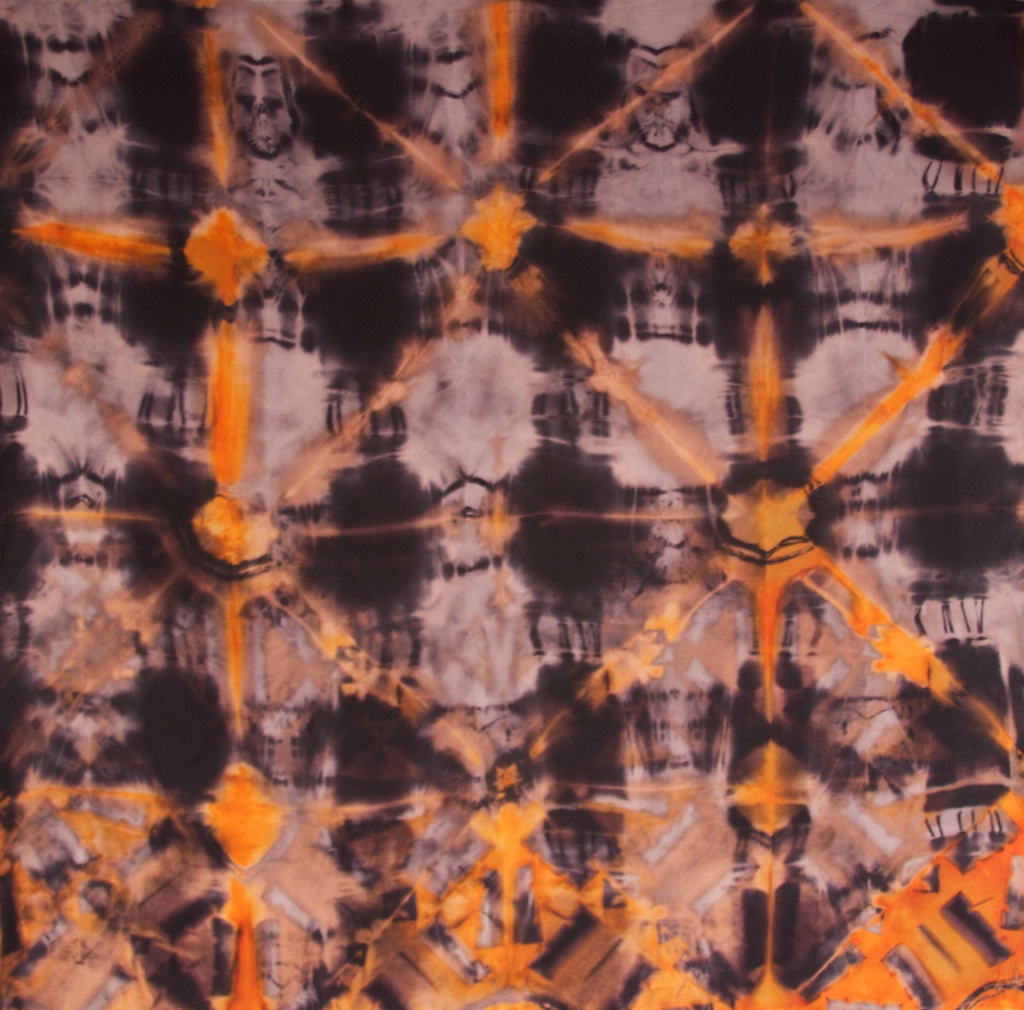


Clamped resist on white fabric dyed black.


Dyeing to Discharge: Day 5
Well, actually this post is more like post-day 5. I'm home in College Park and exhausted. I can't figure out what I did to be so pooped except that I must have worked harder this week than I thought.
- First and foremost: I've been ignoring a really valuable design tool--discharge--because I was squeamish about the safety, mess, etc. After a week of working with this stuff and never feeling any ill effects I feel well prepared to do more discharge work, and to do it in a way that's safe.
- Tied for first: This stuff is great, but anyone using any form of bleach or reducing agent needs to wear a respirator when using it and work outside. [That goes for using Tilex in the bathroom too. Close the door, open the window, turn on the fan, wear an acid/gas respirator, leave the room when you're done, and don't come back until the smell is gone. Don't laugh. I'm totally serious. I've made myself sick in the past from chlorine and I will never do it again.]
- I'm going to try a few more experiments with MX primary combinations and work on developing a vocabulary of discharge colors, effects, and marks that speaks to me. In a lot of ways workshops like this one are like going to a wine tasting. You taste some things you like and some you don't, and after a while your palette needs a rest to recover from the over-stimulation.
- MX acid process for silk! I've got to do more of this. I've got all of the supplies; I just need to fine tune my technique. [Of course Carol teaches a 5-day action packed class just on silk, but I can't think about that now. Too tired.]
- I want to work on black and white textures through discharge. Is it really possible that there's a pleasing combination of MX primaries out there that discharges to white? It doesn't seem that way, but...
- I'm going to experiment with potato dextrin as a resist and see if I can use it in a way that works for me. I'm not really interested in slathering yardage and waiting for it to crackle, but the stuff washes out so much easier than some other resists that it's worth playing with.
- Finally, I bought some monagum [the giant PRO Chem order should arrive on Wed] and I'm going to make my own thickened bleach discharge paste from now on. No more dishwasher gel.
Bottom line: I learned some new things and a lot of good safety tips. I definitely recommend this workshop for anyone interested in working with discharge techniques. Yes, you can figure this stuff out on your own, but this is a great way to jumpstart the process and get a good and SAFE start.
Dyeing to Discharge: Day 4
Yesterday was the 4th day of class. Time is flying by--faster than usual. The sample books are all done and it will be a valuable reference. As I was replaying the day in my head last night I started thinking about the work hanging on my design wall at home. One of the things that I wanted to accomplish this week was to work on new ideas for how I would add complexity to that composition through discharge. I've got some ideas, so mission accomplished.


Dyeing to Discharge: Day 3
I've only got time for a quick post, then I need to get to sleep. Day 3 was good. Today we wrapped up the exploration of chlorine bleach with some work with thickened bleach using Monagum. I discharged a piece of rayon that I prepared yesterday with potato dextrin crackle. I don't think I need to do that again. It's just a big mess. Yes, it does create an interesting pattern, but one that is very distinctive--as in, "Oh look he used potato dextrin." Someone observed that while it might be obvious to other surface designers, there's a whole world of folks out there who find the crackle pattern very engaging. It just doesn't speak to me.
We also did a bit of work with thickened thiox. Now, I've done this before and always found the smell a bit overwhelming. Today we all were able to screen, print, paint, etc. indoors with no ill effects. Of course the ironing to activate the discharge was all done outside with respirators on.
After dinner this evening I spent a couple of hours stitching up a T-shirt and a piece of silk for a bit of stitched shibori tomorrow.
Learning lots and still having fun. Pictures tomorrow.
Dyeing to Discharge: Day 2
Another good day, but that's not really a surprise. I think I could actually take this class at a faster pace, but the group is a mixture of folks who have previously studied with Carol and some who haven't. Everyone has had some MX experience, so that's helping move things along.


Dyeing to Discharge: Day 1
It was a good day. We spent a while talking about some general concepts concerning discharge, but the real thrust of the day was making the first round of samples. We dyed samples of all of the pure MX dyes and all of the PRO Chem blacks on both silk and cotton, then discharged those along with some commercial black samples with thiox, chlorox, and deColourant (that new stuff that everyone's so excited about). I've done little tests before--a dab of bleach on the edge of a piece of cloth to predict what I might get before embarking on a broader application. But, I've never done so many samples at a time or with such a broad range of colors. It's amazing to see all of the possibilities. Tomorrow everything gets assembled into a sample book, which we'll use to make design decisions for the rest of the week.
A week in Fall River
I'm in Fall River at PRO Chemical for a 1-week workshop with Carol Soderlund called "Dyeing to Discharge." It's hard to believe, but this will be my 5th class with Carol. I'm going to have to ask for a degree soon.
"Unexpected Patterns" opens today


"Unexpected Patterns" (aka "Unexpected Patterns: Quake!") opens today at the Worcester Center for Crafts in Worcester, MA. If you're in the area check out my piece in this show along with the other outstanding work by members of the Art Cloth Network.
Saving the hopeless quilt: Part 4
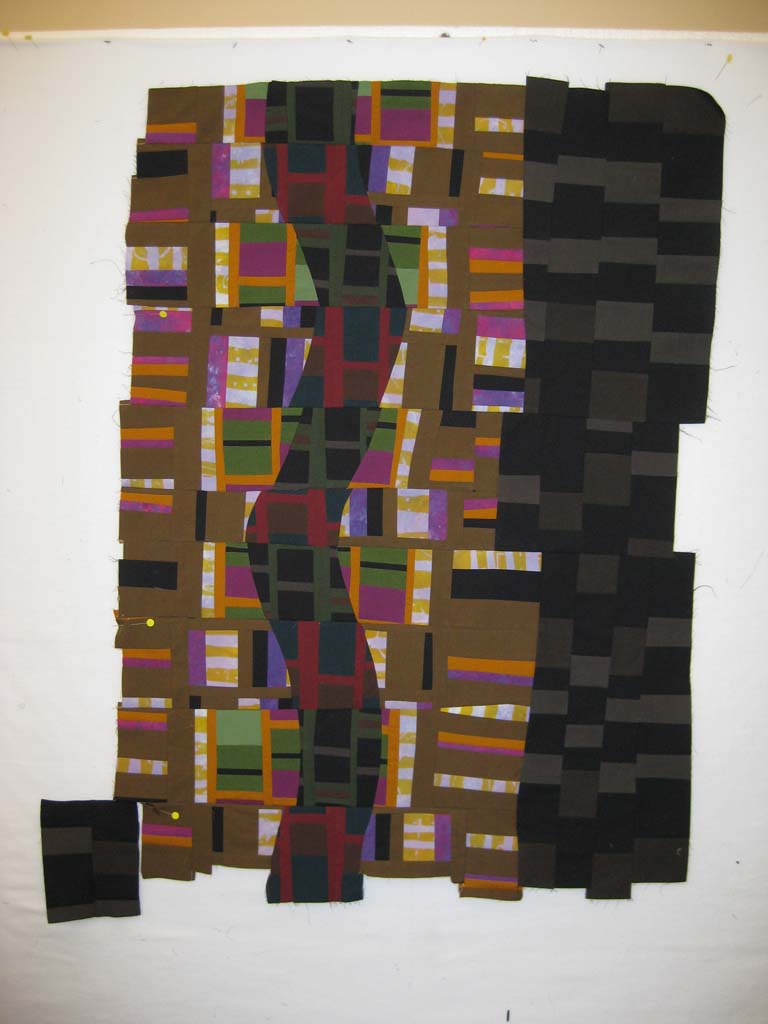
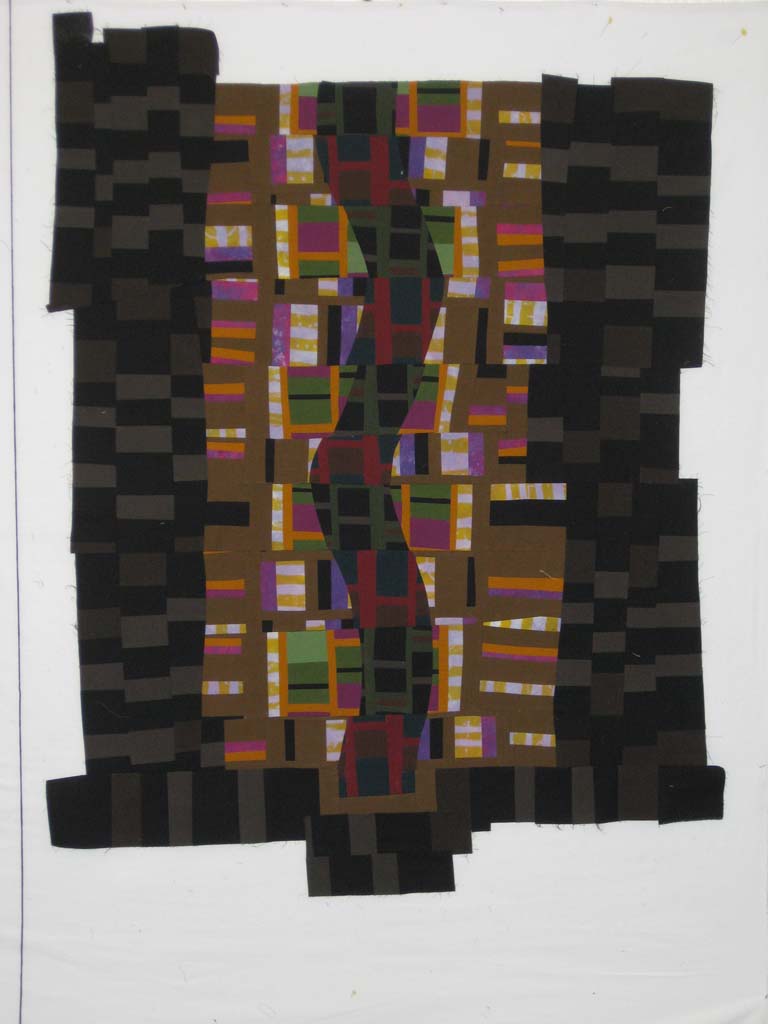
As I began to assemble it I realized that the little piece of the curved middle strip that was extending below the rest of the design was something to which I'd become attached. From the purely practical perspective of construction, this was not the best time to come to this realization because it meant even more seam ripping than I was already doing, not to mention scavenging through the scrap pile in search of bits of fabric that I was out of.

Saving the hopeless quilt: Part 3

