Thoughts, news, and more
Recent posts

"Material View" on exhibit in Illinois
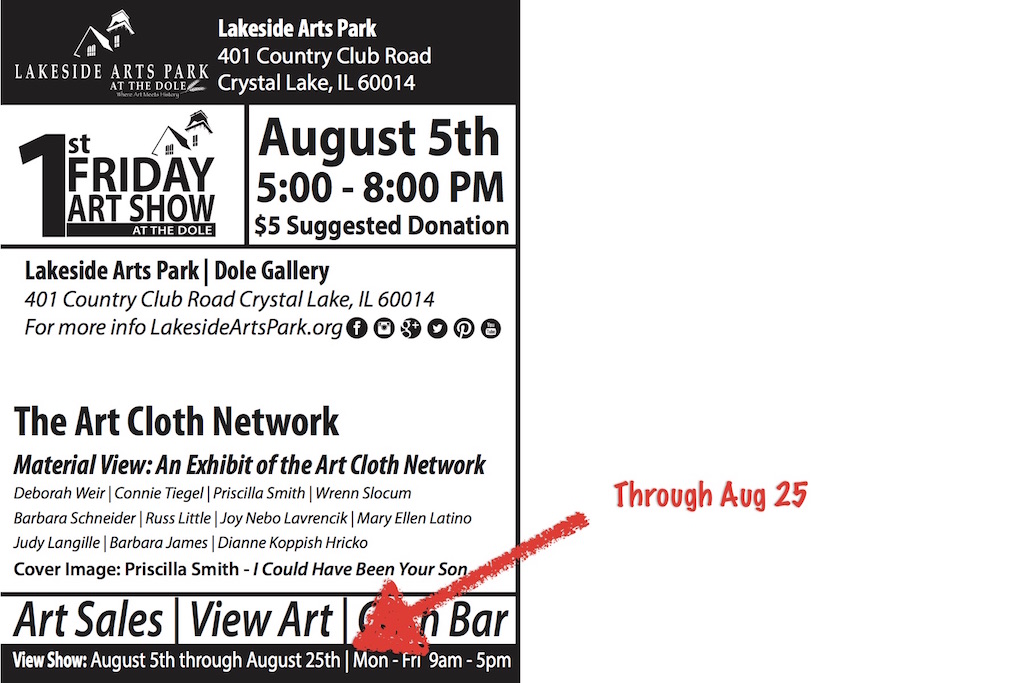
I've currently got a piece of art cloth hanging in an Art Cloth Network show at the Historic Dole Mansion in the Lakeside Art Park in Crystal Lake, Illinois (NW of Chicago). The show runs through Aug 25th. Stop by and have a look if your summer travels take you to Chicagoland.
Here's a photo of my work in the gallery. I confess that it's always a little bit of a thrill to see a piece hanging in a show.

My piece is the one at far right, "Circular Recursion #1" (credit: Barbara Schneider)
Here are images from the postcard for the First Friday opening reception. The face of the card features the work of Priscilla Smith. Special thanks to ACN member Barbara Schneider who got us this venue, installed the show, and gave the gallery talk at the opening.

Human Marks : Day 5 (final thoughts)

[Edited 5/28, 10:00 PM to correct typos]
I took this photo on a walk after lunch Thursday for both inspiration and memory. It might sound a little precious, but I keep thinking "Rows of corn; rows of stitching." In some way that I don't yet fully understand, that seems to encapsulate this week. One of the things that's really staying with me is the stitching--on fabric, on paper, alone, and in small circles of new friends. Stitch is transformative. It joins fabric into garments to cover and protect out bodies; it decorates functional items; it's a tool for artists. And yet stitch, like weaving, has become mechanized to the point that we hardly give a thought to its presence in our lives.
I have sewing machines that can make 1,500 stitches per minute, and others that sew with 3 or 4 needles at a time. I treasure and rely on these tools to do my work, and I'd hate to be without them. Gosh, I wonder if I even managed to sew 1,500 stitches by hand this week! Not too many generations ago (and still today in some places) hand stitch and hand weaving were more the norm than the exception. Textile, thread, and needles were treasured. Garments were cared for and mended. As a consequence of industrial sewing and weaving, garments have become disposable. We replace rather than mend, and more often than not, we replace out of a desire for the new and chic.
More troubling than our cultural perception of garment and textile as disposable, is our expectation of an unending supply of product at an affordable price. Machine or no machine, someone is making the clothes you wear, even those purchased at a discount store for less than you might spend for lunch. Add to this thought the notion that hand stitched embellishments are time consuming and done entirely by people, not machines.
I feel as though I'm rambling and grasping to draw these thoughts together. It's basically this: Somebody made my clothes, linens, etc. Even if I made some of the clothing, I didn't weave the fabric. Think of all the people involved in the production of a single garment and all of the folks taking their share of the profit. How much money makes it back to the person with his or her hands in the soil or on the sewing machine, or stitching away by hand?
I don't know what to do with that question except to be with it in the hope that greater mindfulness and better stewardship will follow.
It's been wonderful to spend another week at the Barn, to reconnect with a few old friends, and make new connections. Stated simply, Dorothy Caldwell is not only a gifted artist, but a generous teacher. She has a talent for gently moving around the room, connecting with each of her students, and offering suggestions and words of encouragement that seem to keep each person on track--whatever that individual's track might be. Along the way she also interjects thought-provoking ideas, like our discussion and practice of hand stitching, which led to the thoughts above. If you're a visual artist of any sort then I say you can't go wrong with one of Dorothy's classes.
Human Marks : Day 4

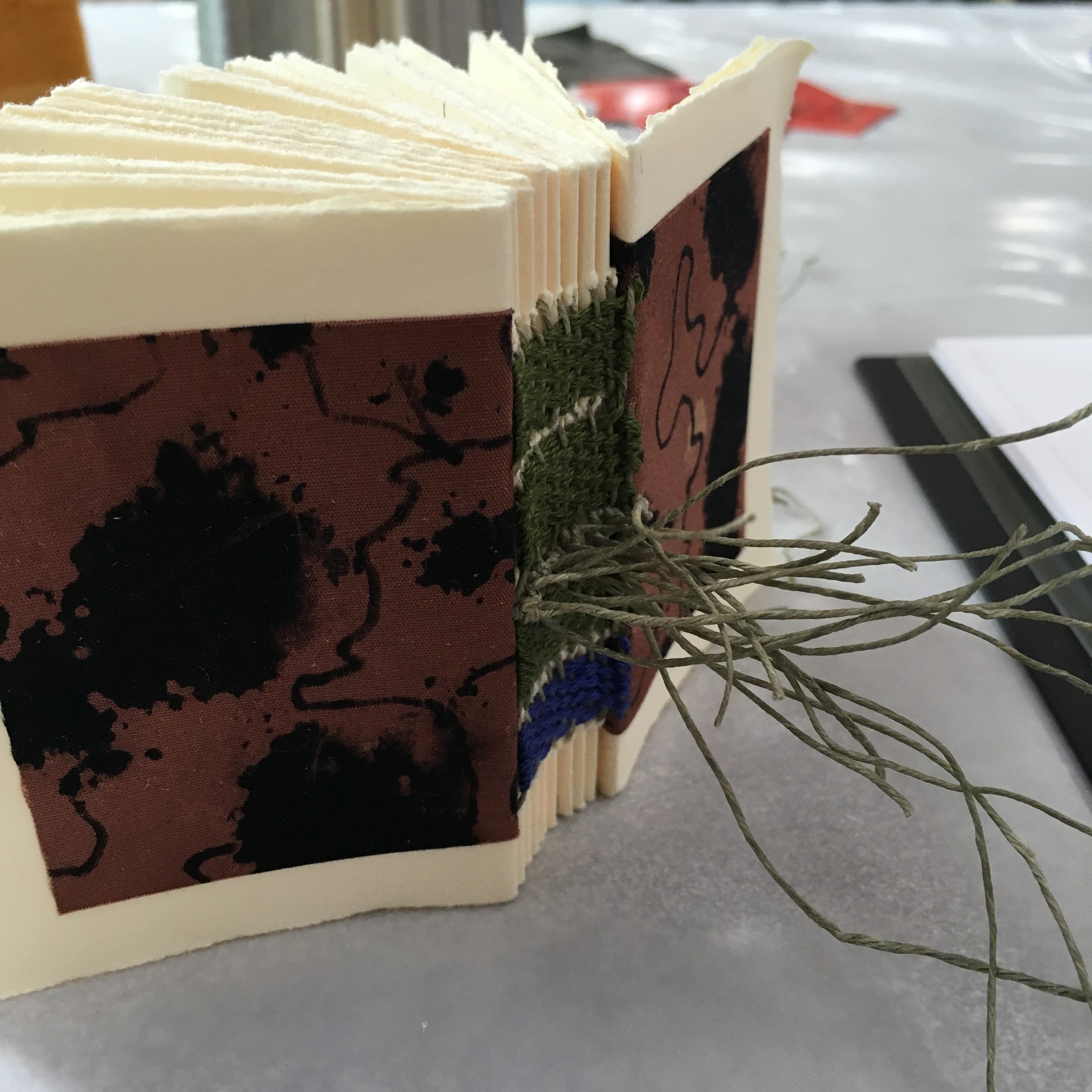
Today was all about bookbinding. Well, sort of. The task of binding our books superficially involved the mechanics of a simple stitched binding. On a deeper level it was an exercise in recognizing and solving a whole series of design problems. The pages that we've created this week all have a fold down the middle like a greeting card. Folded in half they form 4 pages. Assembling a book with some sort of flow involves sorting, selecting--and in come cases modifying--these groups of pages so that they work together, even though we didn't really plan how this was going to work from the outset. It was a great exercise. The photo above shows the end-of-day status for all of my projects for the week. Some things are not totally finished, but finished enough for the group review tomorrow morning.
The photos below show the binding for one of the books coming together. This was seriously fun and I think I might be doing more on my own.
Book signatures (groups of folded pages) assembled and ready for binding.

All of the signatures individually stitched with waxed linen thread and held together temporarily with a rubber band.

The final bound book. The signatures are all connected together by weaving embroidery floss through the waxed linen threads along the spine edge of each signature. That crazy nest of waxed thread hanging off the spine of the book is staying as a design element (it's art).
Human Marks : Day 2 + 3
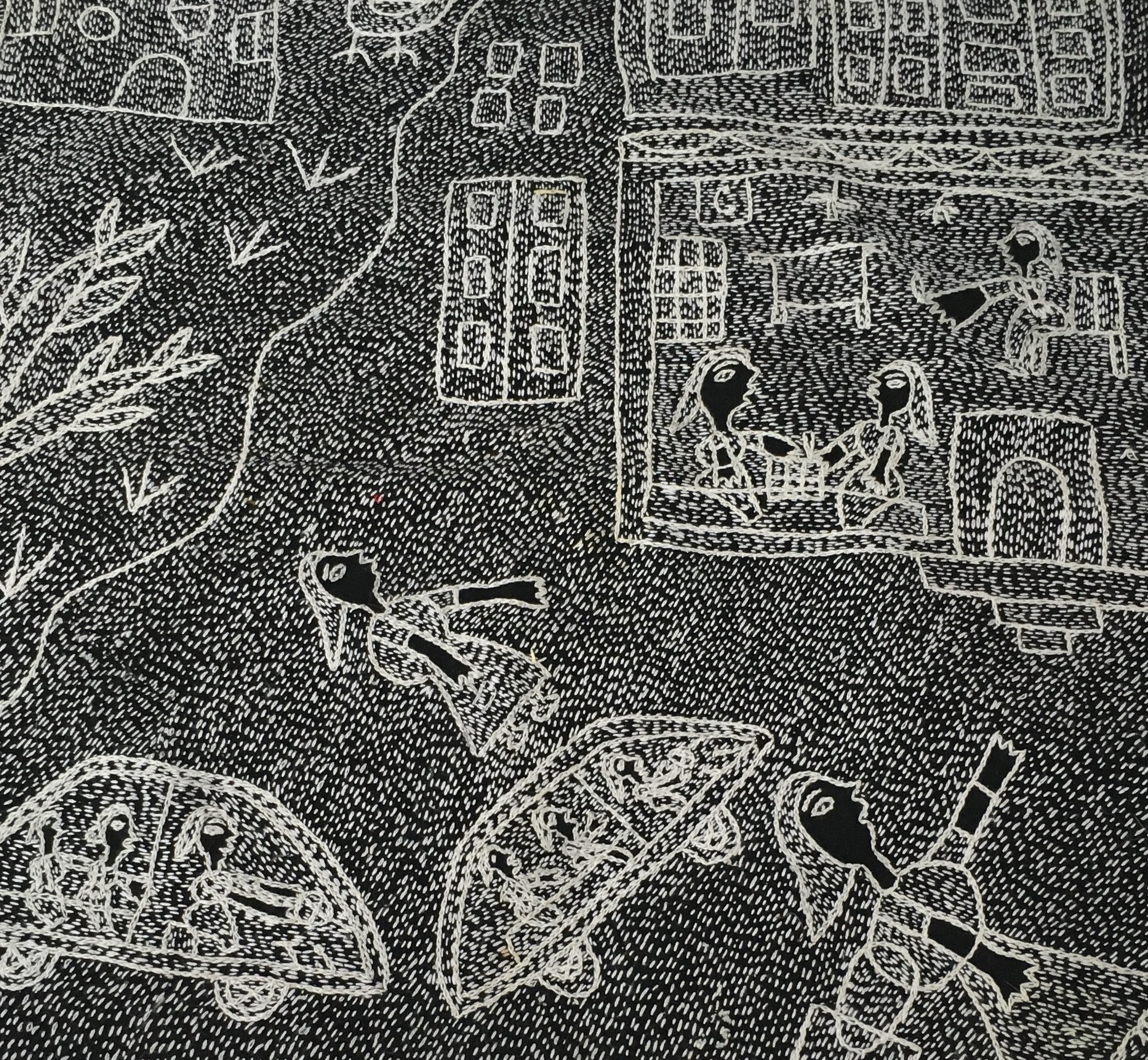
Indian Kantha sample from Dorothy's collection.
Sorry for not posting yesterday. It was a LONG day. I got back to the hotel around 9 and continued stitching until about 1030. Yesterday started with a fantastic slide talk about kantha stitching in India (https://en.wikipedia.org/wiki/Kantha) and the work that Dorothy and some of her colleagues have done to document and support the work of local women. As I said in the Day 1 post, we're collecting our work into a hand bound volume. Yesterday we spent the better part of the day stitching a kantha-style cover for the book. How hard or time consuming could that possibly be? The answer is rather. Most of us aren't hand stitchers, so there's a bit of re-learning and slow going, but we're all making great progress between yesterday and today. The underlying lesson is that the oh-so-affordable hand stitched souvenir from your vacation or that catalog item from India or elsewhere was made by someone who labored for days to create it. Think about that and then look again at the price. It's sobering.
This is were I started: blank cloth and simple tools.
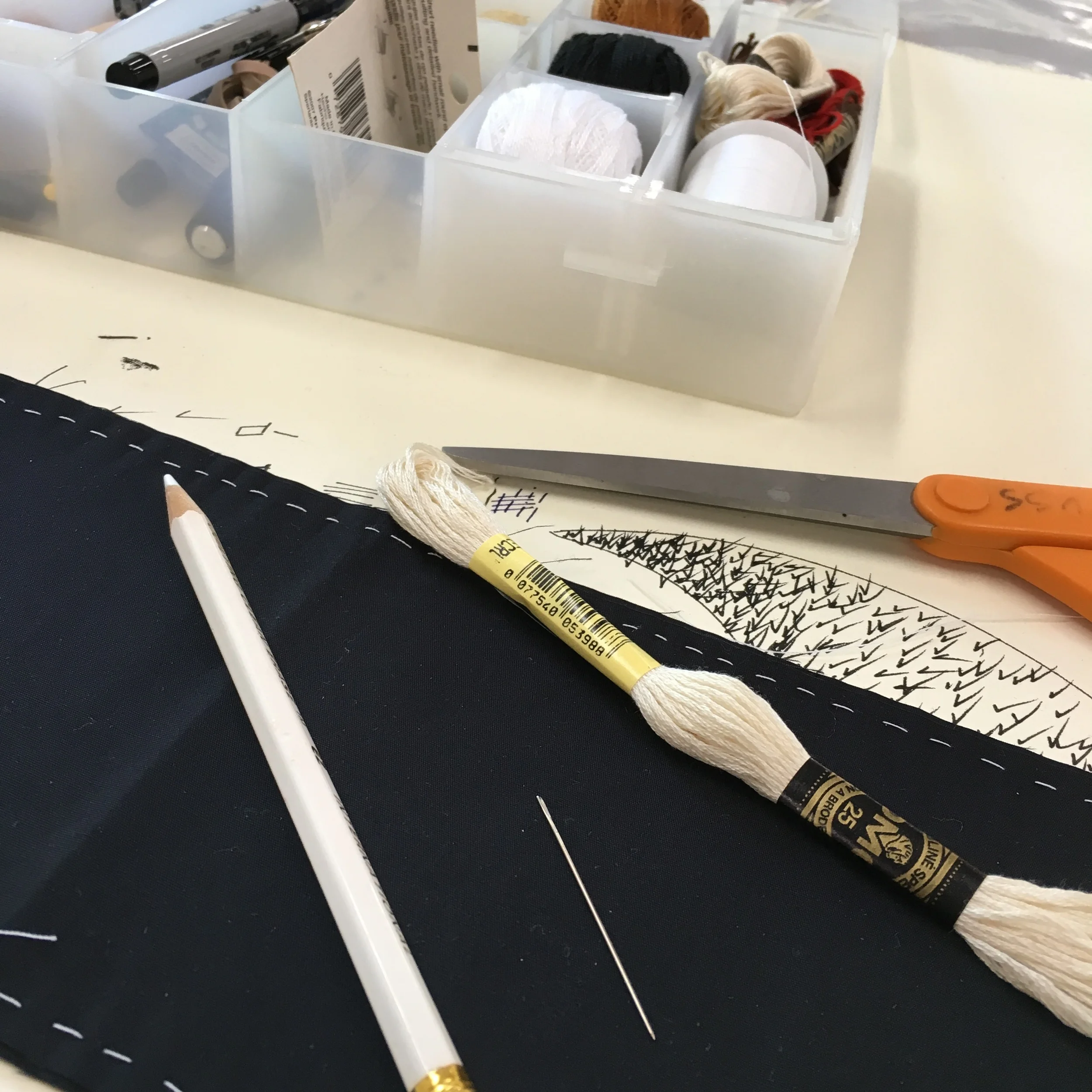
By about mid-day today I was here.


Betwixt and between bouts of stitching there've been more slide talks, more mark-making exercises (including taking a hammer and nail to paper!), great food, and wonderful conversation and camaraderie. We've got a really great group of super-talented folks in class and there's great energy flowing.
Human Marks : Day 1
I'm here in Ohio at the Crow Timber Frame Barn (nancycrow.com) for a one week workshop with Dorothy Caldwell (dorothycaldwell.com) titled, "Human Marks". I've admired the mark quality in Dorothy's work for many years, and countless friends and colleagues have recommended her workshops. I'm thrilled to finally have an opportunity to study with her.
As the name says, this workshop is all about human marks made in a variety of ways--fingerprints, pen, paint, burning, stitching, etc. The tangible end product will be several small hand bound books containing the results of our mark-making exercises. The intangible "product" is that there really isn't a product per se. We're making these marks without purpose, and the books will be a collection with no purpose other than to be an artifact of the time. The marks aren't intended to be representational or patternistic. They just are.
It's a rare thing for me to spend five days doing something that isn't driving toward a goal. I'm enjoying it. Here are a few samples of today's work.
Marks make with a pen (mine's the one in the center).

Marks make with a brush and india ink. The tall piece to the right make with fingerprints. The small bits on the far right are marks burned into cloth with incense.

Just posted a new "how to" on hanging art cloth

Check out the new "How To" tip that I just posted in the Resources section of my website explaining how I hang art cloth.
http://russlittlefiberartist.com/how-to/2016/4/29/how-to-create-a-top-sleeve-for-hanging-art-cloth
Beginning the new adventure

Updated 1/27/2016 to correct an intolerable number of typos.
I took off the last 2 weeks of December in anticipation that the last day of the year would mark my last day at National Geographic after almost 26 years--that's 9,448 days, but who counts. It was an amazing experience--many jobs, at least 2 careers, and tremendous people, all under a single roof. The decision to leave was not taken lightly or made with ease. The recent reorganization (just Google "Washington Post National Geographic") presented me with both a job opportunity and a chance to take a voluntary separation package. I chose the latter. I hope that years from now I can have a Frost-like moment when I can rightly compare this inflection point in the arc of my life story to those roads in a yellow wood. I confess that having just reread "The Road Not Taken," I'm struck by just how very appropriate it is to the moment.
So here I am, nearly a month later. I've had a couple weeks of holiday slacking, followed by a couple weeks of a lingering, gurgling, post-holiday virus, which I can always count on before Epiphany. I've cleaned the closets, remembered how to cook, cleared the backlog of ironing, and tidied my desk. And of course we've had a blizzard, affectionately dubbed "Snowzilla". Now what? I suppose it's time to embrace this whole idea of being a self-employed artist. You see, that's what this leap of faith is supposed to be about--moving from my day-to-day corporate job to being a full time working artist. The universe has seen fit to send me several bits of reassurance that I've made the right decision: a supportive husband, a host of friends cheering me on, a small show at the New Deal Cafe, and a commission that I'm hoping to finalize within a week. I'm grateful.
What's missing at this point is a routine, my great boss, and my work friends.
A regular rhythm to my day is only just starting to come together. I like a certain amount of routine and a certain amount of flexibility, but I'm little surprised to find just how aimless one can become when all structure is taken away.
I've had good bosses and bad bosses--and I mean seriously bad. I was fortunate to leave NGS on a high note, having spent most of the last 2 years working for a great boss. I miss having a leader I can follow with confidence and someone who I knew was thinking faster and farther than I was. Now that falls to me. I get to be both the leader and the follower. It's great to lead; sometimes it's also nice to follow--just saying.
I love days spent in near silence, or perhaps with an audiobook or NPR. Having said that, I can also say that a week spent that way will definitely make you appreciate the folks with whom you used to spend your days. This is my opportunity to make new connections, but I miss my colleagues.
That's the news. Whatever I write next (could that possibly be as early as tomorrow?) will be about what comes next.
Craft fair this Sat & Sun

If you find yourself in the Washington, DC area this weekend, make time to stop by my booth at the Greenbelt Festival of Lights Art & Craft Fair. Come early before all of the best stuff is gone. Hope to see you there.
Saturday, Dec 5, 10am - 5pm
Sunday, Dec 6, 10am - 4pm
New show booth in the making


This post could also be titled, "What I did over my Thanksgiving break." My craft show booth has evolved over the years, but has always been variations on a basic pipe-and-drape design--essentially a curtain backdrop. I'm about to do my 5th show (admittedly my 5th in 5 years, but still...) so I decided to up my game a bit. I've looked at several options for purchasing a booth, but (a) they aren't cheep and (b) they can be bulky. My solution needs to fit in a 4-door car with the rear seat folded down. That means it needs to break down to a small package.
My solution was a 7' tall folding screen with options to add or remove panels to accommodate different spaces. The pictures above show various stages of production as well as the fully disassembled state. I designed it to have an intentionally raw wood, knocked together look. So far I'm pleased with the result. This morning it'll get the last coat of shellac to protect the wood, then I just need to make the fabric panels that will be stretched in the frame.
I'll post photos of the finished creation in action next weekend when it's all set up at the Festival of Lights.
Check out the new items in my online store

Black Friday? Really? Isn't there still a pile of Thanksgiving dishes in the sink?
Whether you're a conservative shopper or an an all out shopping maniac, it is indeed the time of year when we all begin to contemplate gifts for friends and loved ones, and perhaps for ourselves. It's also an incredibly busy time of year for everyone involved in creating, marketing, and selling. I know I've certainly been busy.
Click on over to my online store and see some of the newest creations. Buying from local merchants and small businesses is a great way to support the community. These folks--people just like me--are wonderful source for original, one-of-a-kind gifts.
And, if you find yourself in the Washington, DC area next weekend (Dec 5-6), stop by my booth at the Greenbelt Festival of Lights craft fair to see more of my work.